
The Ideological Roots of Indology — Aryan Invasion, German Romanticism, and the Manufactured History of India

Aryan Invasion
In 1786, in a lecture before the Asiatic Society of Bengal, the British judge and philologist Sir William Jones made an observation that would alter the course of European scholarship for two centuries. Sanskrit, he said, "bears to both Greek and Latin a stronger affinity, both in the roots of verbs and in the forms of grammar, than could possibly have been produced by accident; so strong, indeed, that no philologer could examine them all three, without believing them to have sprung from some common source." It was a careful, evidence-based linguistic observation. It launched comparative philology as a discipline. It also launched something else — a sprawling 19th-century European project to locate that "common source" geographically, ethnographically, and racially.
The project produced the Aryan Invasion Theory. And the Aryan Invasion Theory, in turn, produced almost every distortion of Indian history that thoughtful NRIs still meet on abroad university campuses today.
To understand why so much of what passes for "the academic consensus on India" rests on shaky foundations, one has to understand who built those foundations, when, and why.
The German romance with an imagined Aryan homeland
Through the late-18th and 19th centuries, German intellectual life was searching for a foundation myth. Germany was not yet a unified nation, and its scholars, poets, and philosophers — Herder, Schlegel, Schopenhauer, Hegel, and later the Grimm brothers — were hunting for the deep cultural ancestry of the Germanic peoples. Sanskrit, suddenly available to European scholarship after Jones, presented an irresistible possibility. Here was an ancient, sophisticated, ritually rich Indo-European language whose speakers could be claimed as distant cousins of Europeans — racial kin, separated by millennia but reunited by philology.

The German Romantic project read the Ṛgveda as a window into the original Indo-European homeland and the original Indo-European people. Friedrich Schlegel published Über die Sprache und Weisheit der Indier (On the Language and Wisdom of the Indians) in 1808, treating India as the cradle of human civilization. By the mid-19th century, the enthusiasm had cooled into a more racially loaded narrative. The "original Aryans" were now imagined as fair-skinned pastoralists from Central Asia or southern Russia who had migrated outward — westward to Europe, southward into Iran and India — bringing language, religion, and what would later be called "civilization."

Friedrich Max Müller, the German-born Oxford professor whose multi-volume edition of the Ṛgveda and translation series Sacred Books of the East remained standard for a century, gave this scheme its most influential popular formulation. In his Cambridge lectures of 1872 and his later writings, he proposed a date for the Vedic compositions — roughly 1200–1500 BCE — that was calculated, by his own admission, on the basis of a literalist Christian-biblical chronology that placed the Flood around 2400 BCE and required all post-Flood developments to fit between that date and the supposed compilation of the Vedas.
Max Müller himself, late in life, repudiated his dating with unusual candour. "Whether the Vedic hymns were composed 1000, 1500 or 2000 or 3000 BC, no power on earth will ever determine," he wrote in 1890. But the 1500 BCE date had already congealed into textbook orthodoxy. It is still there today in many syllabi.
The Aryan Invasion Theory, as it stabilized by the late 19th century, told this story: light-skinned Aryan invaders entered India around 1500 BCE through the Khyber Pass, destroyed the Indus Valley Civilization (whose ruins were excavated from 1921 onwards at Harappa and Mohenjo-daro), enslaved the dark-skinned indigenous Dravidians by inventing the caste system, composed the Vedas as a record of their conquest, and gradually moved eastward and southward over the following millennia.
It was a tidy story. It served three audiences at once. It flattered European racial self-conceptions by giving Europeans an ancient, sophisticated, non-Semitic ancestry. It justified British rule of India by recasting the British as merely the latest in a series of fair-skinned conquerors, this time bringing modern civilization rather than Vedic religion. And it provided early Indologists with a master narrative into which every textual, archaeological, and linguistic finding could be slotted.
There was only one problem. The evidence kept refusing to confirm it.
Where the theory began to fail
The first cracks appeared in archaeology. From the 1920s onward, excavations of the Indus–Sarasvati civilization revealed an urban culture far more sophisticated than the supposed Aryan invaders should have encountered — planned cities, standardized weights, sophisticated drainage, granaries, dockyards (Lothal), and a script that still resists decipherment. Crucially, no archaeological layer of destruction corresponding to a 1500 BCE invasion has ever been securely identified. Sir Mortimer Wheeler, who excavated Harappa in the 1940s, famously pointed to a few scattered skeletons in Mohenjo-daro and proclaimed "Indra stands accused" of the destruction. Later analysis showed those skeletons were from different periods, none consistent with a single massacre event, and the site shows gradual decline — likely linked to the drying of the Sarasvati river system and shifts in monsoon patterns — rather than violent overthrow.
Then came hydrology. Satellite imagery from the 1980s onwards, particularly from the Indian Space Research Organisation's (ISRO) IRS satellites and from NASA's Landsat program, confirmed the existence of a massive paleo-river running roughly parallel to the Indus on its eastern side — the Ghaggar-Hakra system, which most researchers now identify with the Vedic Sarasvati. Geological dating of the river's drying places its major desiccation around 1900–2000 BCE. The Ṛgveda repeatedly describes the Sarasvati as a mighty flowing river. If the Vedas were composed after 1500 BCE, as Max Müller's chronology demanded, this is hard to explain. Either the Vedic poets were describing a river that had dried up several centuries before their birth, or the Vedas are older than the orthodox dating allows.
Ref. https://reich.hms.harvard.edu/sites/reich.hms.harvard.edu/files/inline-files/eaat7487.full_.pdf
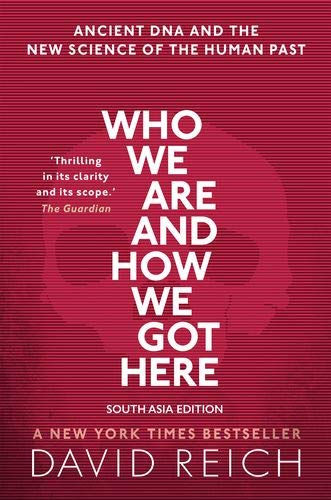
Then came genetics. From the early 2000s onwards, large-scale studies of Y-chromosome and mitochondrial DNA haplogroups in South Asian populations have produced a complex picture that resists the simple invasion narrative. There is evidence of ancient population mixture in South Asia, including some contribution from Steppe-pastoralist sources during the second millennium BCE — this much is now reasonably well-established by ancient DNA work led by David Reich at Harvard and his collaborators, including Vagheesh Narasimhan's 2019 paper in Science. But the simple picture of light-skinned Aryans displacing dark-skinned natives has been decisively rejected even by the genetic researchers themselves. The Indian population is genetically the product of millennia of complex mixture, not a recent racial overlay. Reich himself has been careful in his 2018 book Who We Are and How We Got Here to distinguish genetic findings from political readings of them.
The most careful contemporary scholarship now speaks of an Aryan "migration" rather than "invasion" — smaller-scale, gradual, with linguistic and cultural transmission rather than mass population replacement. Even this is contested. Indian scholars including B. B. Lal (former Director-General of the Archaeological Survey of India), Dilip Chakrabarti (Cambridge), Shereen Ratnagar (formerly JNU), Edwin Bryant (Rutgers), Michel Danino, and Nicholas Kazanas have published extensive critiques of even the migration model, arguing for substantial cultural continuity between the Indus civilization and Vedic-period India. The debate is ongoing, not closed.
Why this matters for the NRI conversation
The point is not that "Aryans never came" — that question remains open and is properly the subject of continued scholarly work. The point is that the version of Indian history that most Indians and most NRIs were taught in school was the late-19th-century version, not the current state of the evidence. They were taught that the invasion was a settled fact, that the Vedas were post-invasion compositions, that caste was an Aryan imposition on a Dravidian population, and that India before 1500 BCE had no Vedic culture at all.
Almost every element of this is now contested by the very disciplines — archaeology, philology, hydrology, genetics — that were supposed to confirm it. Yet it persists in textbooks, in popular journalism, and in the casual abroad university classroom where an NRI undergraduate first hears it from a professor whose own training was in the 1970s or 1980s, before most of this revision had filtered into the field.
The second great distortion concerns motive. European Indology of the colonial period was not a neutral academic enterprise. It was structured by three powerful drivers that had little to do with India itself.
The first was Christian missionary commitment. Many of the earliest Sanskrit scholars were missionaries or were funded by missionary societies. Max Müller's edition of the Ṛgveda was funded by the East India Company on the explicit understanding that it would help missionaries undermine Hinduism by exposing what were assumed to be its primitive origins. Müller wrote candidly to his wife in December 9, 1867: "The translation of the Veda will hereafter tell to a great extent on the fate of India and on the growth of millions of souls in that country. It is the root of their religion, and to show them what the root is, I feel sure, is the only way of uprooting all that has sprung from it during the last 3,000 years."

The second was the German Romantic and later Nazi-period appropriation of "Aryan" as a racial category. By the early 20th century, the word that Indians had used in their own texts to mean "noble" or "civilized" had been transformed in European discourse into the name of a Nordic master race. The Nazi appropriation of Aryan and the swastika did not invent this racial reading — it amplified what 19th-century European Indology had already constructed. After 1945, the racial vocabulary became embarrassing and was quietly retired from polite scholarship, but the underlying framework — the assumption of an outside-in civilizing migration — remained.
The third was the political utility of the invasion theory for British rule. If India had always been ruled by successive waves of foreign conquerors, then British rule was simply the latest such wave, and the call for Indian self-rule was historically incoherent. The colonial administrator Vincent Smith, whose Oxford History of India shaped generations of Indian textbooks, made this argument explicitly.

The cumulative effect of these three drivers was that the academic study of India in Europe and America was built on foundations that would have been unrecognizable, and unacceptable, to any of the actual Sanskrit scholars whose work was being studied. The Indian tradition's own account of its history, transmitted through the Purāṇic king-lists, the Jain Tīrthaṅkara lineages, the Buddhist textual chronologies, and the astronomical references embedded in classical literature, was systematically dismissed as mythological. The Western reconstruction, built from outside the tradition by scholars who often did not visit India and almost never consulted living paṇḍitas, was treated as scientific.
What honest scholarship looks like
A genuinely scientific approach to Indian history would treat the Indian tradition's own sources as data — not as gospel, but as evidence — alongside archaeology, linguistics, genetics, and hydrology. It would notice when the tradition's own claims (a mighty Sarasvati, deep antiquity for the Vedas, continuity rather than rupture between Vedic and Indus civilizations) align with independent material evidence. It would notice when they do not. It would acknowledge open questions honestly and resist the temptation to write a tidy narrative where the evidence supports a messy one.
That kind of scholarship is now beginning to emerge, principally from researchers willing to read Sanskrit and treat its testimony as worth engaging. The work is uneven, the field is politically charged, and there is no shortage of bad scholarship on every side. But the days when the 19th-century framework could be cited unchallenged are ending.
The practical takeaway is this. When a friend says "Indian history is mostly myth," the correct response is not defensive denial. It is: which version of Indian history do you mean? The 19th-century European reconstruction, which is now contested at almost every major claim by the very disciplines that originally produced it? Or the Indian tradition's own self-account, which a serious scholar would treat as primary evidence rather than dismiss unread?
The conversation usually ends there. Not because the somebody won, but because the question has been honestly framed for the first time.
-Acharya Vijnasu

